
Today’s buyers are more informed, more connected, and more cautious than ever before, making it essential for modern sales professionals to understand how purchasing decisions are researched, evaluated, and ultimately made. In Richmond, no one understands buyer behaviors better than Stacy Thomas. Thomas is the CEO of Good Run Research, a market research firm specializing in qualitative and quantitative research solutions that help brands understand their consumers and position themselves to best appeal to a consumer’s behavior. Working with some of the biggest household-name brands, Good Run crafts custom approaches to solve business challenges at its first-of-its-kind research and event space, The Rec Room.
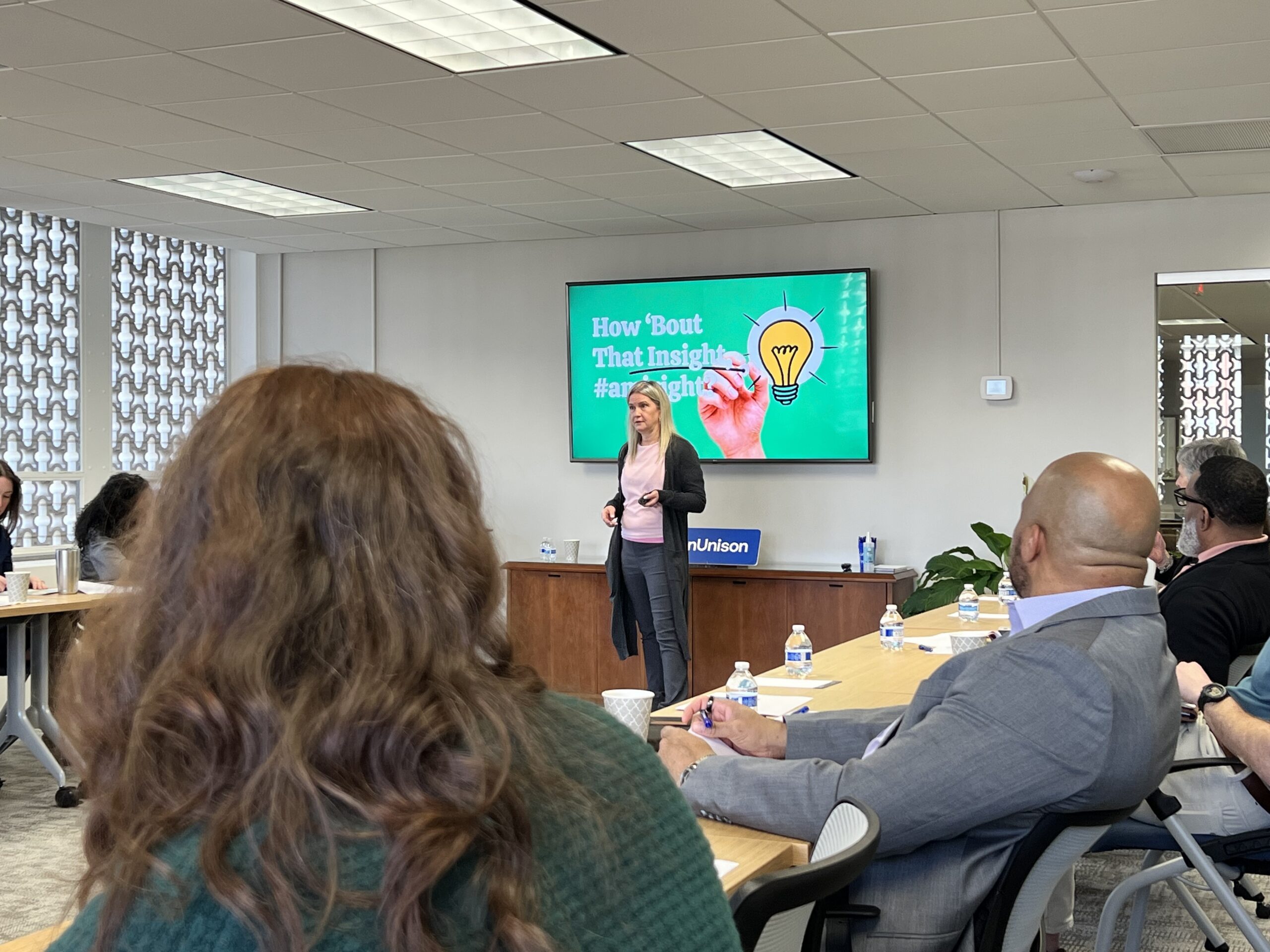
Her extensive career in strategy and research made Thomas the perfect speaker for our Sales 102 event. The workshop focused on understanding buyer behavior and its impact on modern sales strategies. In this article, we will give you the rundown of the key insights and advice Stacy shared during the workshop.
The Great Power Shift
Buyer behavior has fundamentally changed over the past 10 years, but experts say the changes have been happening rapidly since the 2020 COVID pandemic forced consumers out of in-person businesses and onto online marketplaces. The shift to digital-first purchasing means that now buyers hold the power. Gone are the days of shaping a customer’s perception of your business through a sales pitch and introduction. Now, by the time a client reaches out to you, they already know your product, your values, and the public opinion of your business. Potential consumers have access to reviews, bios, company history, and news at their fingertips. “It’s really important that we understand what our buyers already know by the time they get to us,” said Thomas.
The power shift is not only evident in buyer research, but its effects can be observed throughout the entire sales process. “We should probably stop pretending the sales process looks like the nice, neat, organized funnel that we used to know and love,” said Thomas.
Consumers can now decide when the sales process starts, how long it takes, and how much they learn beforehand. This has completely reshaped the sales funnel, as buyers can now bounce in and out of the sales process, loop in others, and compare options more easily than ever. This non-linear sales model has become the new normal, forcing salespeople to adopt a more aggressive, multi-channel approach.
An Era of Uncertainty
Along with access to information and digital shopping, the modern consumer has access to what feels like an infinite number of choices. This leads to what Thomas calls uncertainty fatigue: an overwhelming feeling consumers are developing in the face of too many options. Often, this fear is accompanied by the concern of making the wrong decision or breaking the status quo. The status quo is so powerful because it provides consumers with a sense of safety, making it challenging for businesses to sell innovations across different goods and services. Consumers are often reluctant to change from what they are familiar with. In the modern sales environment, Thomas has found that it is more important for salespeople to make customers feel safe and ease their concerns than to deliver the perfect pitch. Modern buyers are looking for authenticity and connection rather than a flawless sale.
Consumers in the current sales market are not only fearful but also more skeptical than ever. Buyers follow a trust hierarchy when making purchasing decisions; they turn to user reviews, peer recommendations, community feedback, and influencer opinions to overcome their skepticism. This underscores the need for businesses to prioritize relationships and genuine interactions to build trust with potential buyers, who will champion your business in the future.
Differentiating your product in the era of uncertainty is more important than ever. “Most products share more similarities than differences. Your advantage becomes not the thing you’re selling—it becomes the experience,” explained Thomas. She has found that the differentiating factor between customers choosing your product and competitors is often the experience customers have when interacting with a company. Amazon-level simplicity is the new baseline; the expectation of a seamless, straightforward purchasing experience is now the standard for consumers. Brands need to streamline their sales processes to create a hassle-free experience and compete with big online retailers. “In general, it’s just the expectation that it’s going to be very easy, it’s going to be smooth, it’s not going to be fluffy,” emphasized Thomas.
Pivot Your Sales Tactics
In the face of rapid changes in the sales environment, many businesses are being required to make strategic shifts in their sales strategies. While changing your sales mindset from focusing on the close to focusing on the customer experience can be challenging, it will improve your sales and increase customer loyalty.
- Instead of pitching your product, guide your customer. Consumers are looking for guidance rather than the hard sell. Thomas has found that buyers are more receptive to a consultative approach that helps them navigate their decision-making process with confidence. “They don’t want pressure. They’re not looking for a pitch. They are looking for somebody to help them navigate the process that they feel understands them and what’s important for them,” emphasized Thomas.
- Insights are just as valuable as solutions. Often, as a salesperson, you have to identify the problem the client is facing based on the details they provide. Often, the problem they think they are solving is not quite the right one. The key is to “reframe the problem” to highlight your advantage. This allows you to control the conversation and ensure that your unique value aligns with what is most important to them.
- Focus on the buyer’s feelings. By prioritizing the consumer’s comfort and reducing perceived risks, salespeople can foster trust and facilitate a smoother decision-making process. Thomas explained that your role as a salesperson is to make the buyer feel confident in the sale every step of the way, and to do that, you have to ease their concerns by providing evidence of why your product is the right choice with enthusiasm and passion.
Key Takeaways
- Buyers now control the sales process. Today’s consumers do extensive research and have easier access to many options than ever before.Because they enter the conversation already informed, the sales process is no longer linear, giving the customer control over the speed and steps of a sale.
- Uncertainty and Skepticism Shape Modern Buying Decisions. With endless opinions, buyers often feel overwhelmed and anxious that they are making the wrong choices. This can make them hesitant to break from the status quo or be skeptical of products that feel too good to be true.
- Customer Experience Is the New Competitive Advantage. Because many products share similar features and benefits, what often sets a business apart is the experience it creates for buyers. The seamless sales process is just as important to modern consumers as the product itself.
- Successful Salespeople Act as Guides, Not Pitchers. Sellers now serve as guides to help buyers navigate their decisions.By reframing problems, providing insights, and focusing on making a customer feel confident, a sale is more likely to succeed.
Stay tuned for more helpful resources and insights from the Sales 102 presentation. And don’t forget to check out the recap of Sales 101 to learn more about creating a repeatable customer sales journey.